Baccarat Odds & House Edge: What Every Player Must Know
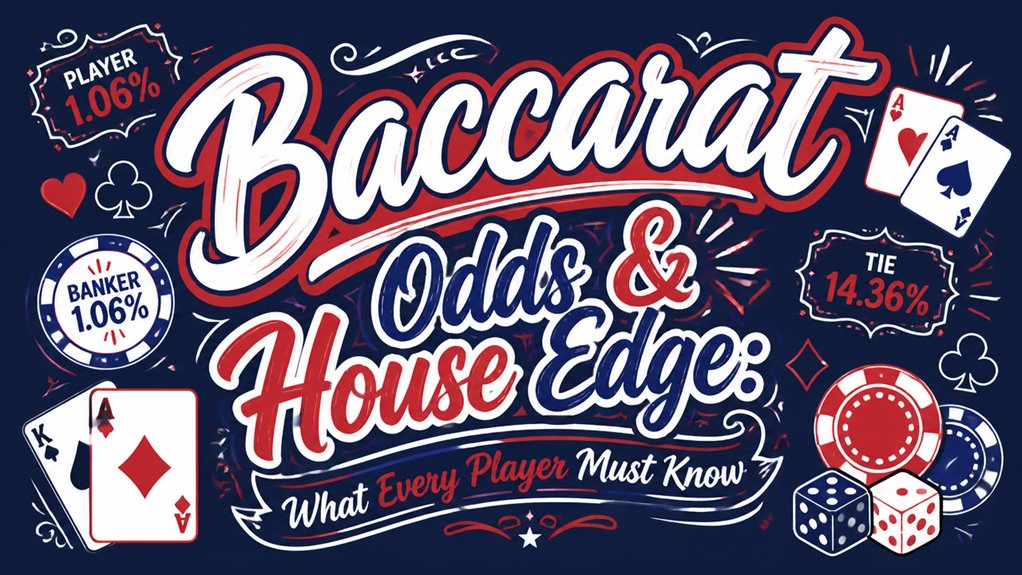
Baccarat carries a reputation for elegance, but beneath the surface lies a mathematical framework that determines every outcome. House edge percentages separate informed players from casual ones. The Banker bet holds a 1.06% house edge, the Player bet sits at 1.24%, and the Tie bet climbs to a punishing 14.36%. These numbers tell a story most players never bother to examine. Understanding them changes everything about how the game should be approached.
Key Takeaways
- The Banker bet offers the lowest house edge at 1.06%, making it the most statistically advantageous wager in baccarat.
- Player bets carry a 1.24% house edge and a 44.62% win probability, making them slightly inferior to Banker bets.
- Despite a 5% commission on wins, Banker bets remain superior due to their higher win probability of 45.86%.
- The Tie bet is the worst wager, with a 14.36% house edge and only a 9.6% occurrence rate.
- Side bets carry significant house advantages, diverting players from mathematically superior options like the Banker bet.
What Is House Edge in Baccarat?
The house edge represents the mathematical advantage a casino holds over players, expressed as a percentage of each bet expected to be retained over time. In baccarat, this figure varies depending on the wager selected, directly influencing long-term outcomes for players seeking ideal returns.
The banker bet carries the lowest house edge at approximately 1.06%, making it the most statistically sound option available. The player bet follows closely at 1.24%, a marginal difference that however compounds meaningfully over extended play. Both options position baccarat favorably against competing casino games, including roulette and blackjack — especially when played on well-established platforms, such as those featured in this guide to online baccarat casinos.
Understanding the house edge empowers players to make deliberate, knowledgeable choices rather than relying on chance alone. Selecting bets with lower house edges represents a disciplined strategy for preserving bankroll and extending meaningful participation at the table.
Banker vs. Player Bet: Which Has Better Odds?
When comparing the two primary bets in baccarat, the Banker bet holds a statistically measurable advantage, with a winning probability of 45.86% against the Player bet’s 44.62%. This difference is further reflected in the house edge figures, where the Banker bet carries a 1.06% edge compared to the Player bet’s 1.24%, making the Banker bet the mathematically superior choice over extended play. As a result, informed players consistently favor the Banker bet as the ideal wagering strategy, recognizing that even fractional differences in house edge compound meaningfully across long-term betting sessions.
Banker Bet Win Probability
Among the two primary baccarat bets, the Banker bet holds a measurable statistical advantage, with a win probability of approximately 45.86% compared to the Player bet’s 44.62%. When ties are excluded, the Banker wins roughly 51% of hands, reinforcing its structural edge.
| Metric | Banker Bet |
|---|---|
| Win Probability | 45.86% |
| Win Rate (Ties Excluded) | ~51% |
| House Edge | 1.06% |
| Commission on Wins | 5% |
| Player Bet House Edge | 1.24% |
Despite the 5% commission applied to winning Banker bets, the house edge remains at 1.06% — significantly lower than the Player bet’s 1.24%. Players who prioritize mathematical efficiency consistently favor the Banker bet, as the data unambiguously supports its superior win probability and reduced long-term cost.
House Edge Comparison Breakdown
Comparing the house edge across baccarat’s two primary bets reveals a clear statistical hierarchy. The banker bet carries a house edge of approximately 1.06%, while the player bet operates at 1.24%—a measurable difference that compounds meaningfully over extended play. Though a 5% commission applies to banker bet winnings, this cost remains structurally offset by the bet’s superior probability advantage. The banker hand wins roughly 51% of the time when ties are excluded, confirming its statistical dominance. Players prioritizing mathematical efficiency gravitate toward the banker bet precisely since its lower house edge preserves capital more effectively. The player bet, while commission-free, surrenders ground through its higher edge. This data-driven distinction between the two options defines rational wagering strategy in baccarat.
Optimal Betting Strategy Tips
Translating baccarat’s probability data into actionable strategy begins with a single, statistically grounded resolution: the banker bet represents the ideal wagering choice. Its 1.06% house edge and 45.86% winning probability outperform every alternative available.
Smart players apply four disciplined principles:
- Prioritize the banker bet consistently, leveraging its superior winning probability.
- Avoid the player bet when possible — its 1.24% house edge erodes returns over time.
- Never place the tie bet — its 14.36% house edge statistically guarantees accelerated losses.
- Track cumulative sessions to measure how reduced house edge translates into preserved bankroll.
Freedom at the baccarat table comes from well-considered choices, not intuition. Data confirms that disciplined banker bet selection remains the clearest path toward sustainable, long-term profitability.
Why Is the Tie Bet a Risky Choice?
The tie bet in baccarat carries a house edge of 14.36%, dwarfing the banker bet’s 1.06% and the player bet’s 1.24%, making it the most statistically disadvantageous wager on the table. In spite of its appealing 8:1 payout, ties materialize only 9.6% of the time, rendering winning outcomes statistically rare. This combination of low probability and high house edge produces consistent long-term losses for players who regularly select this option.
High House Edge Explained
Among the three primary baccarat bets, the Tie bet carries the highest house edge at 14.36%, making it statistically the least favorable option for players. This high house edge fundamentally erodes potential winnings over time. Consider these critical data points:
- Tie bet house edge: 14.36%
- Tie occurrence frequency: 9.6%
- Tie bet payout ratio: 8:1
- Banker bet house edge: 1.06%
Despite the attractive 8:1 payout, the Tie bet’s house edge renders it mathematically disadvantageous. The Banker bet, commanding a mere 1.06% house edge, represents a strategically superior alternative. Players seeking genuine financial autonomy must recognize that the high house edge systematically transfers wealth from player to house, undermining long-term profitability regardless of occasional winning outcomes.
Low Winning Probability Risks
Examining the tie bet’s winning probability reveals a stark statistical reality: with ties occurring only 9.6% of the time, players face nearly five times lower odds of winning compared to the banker bet. This dramatic disparity exposes the tie bet’s fundamental weakness as a strategic choice.
While the 8-to-1 payout appears compelling, the 14.36% house edge systematically erodes any potential advantage. By contrast, the banker bet’s house edge of just 1.06% demonstrates how probability alignment with payout structures determines long-term viability.
Players who value financial autonomy recognize that chasing attractive payouts without statistical justification compromises their bankroll sustainability. The tie bet’s low winning probability, combined with its punishing house edge, positions it as a statistically indefensible option for informed players.
How Baccarat Odds Compare to Other Casino Games
Baccarat stands out as one of the more player-friendly casino games when measured against its competitors by house edge. The baccarat odds consistently reward disciplined bettors who avoid unfavorable wagers. The house edge across major casino games reveals a clear hierarchy:
- Blackjack (optimal strategy): ~0.5%
- Baccarat banker bet: ~1.06%
- Baccarat player bet: ~1.24%
- Pai Gow Poker: ~1.46%
Traditional roulette’s 5.26% house edge dwarfs baccarat’s standard wagers, reinforcing baccarat’s competitive position. The tie bet, on the other hand, carries a damaging 14.36% house edge, representing a statistically poor choice. Unlike blackjack, baccarat requires no complex strategy to access low house edge figures, granting players straightforward control over their risk exposure without demanding advanced skill sets.
Baccarat Side Bets and Their True Cost
Many baccarat side bets carry house edges that dwarf those of the main wagers, exposing players to substantially greater long-term losses. The Tie bet, in spite of its attractive 8-to-1 payout, imposes a 14.36% house edge, far exceeding the Banker bet’s modest 1.06%. Player Pair and Banker Pair side bets similarly exceed 10% house edges, compounding financial exposure with every wager placed.
Players frequently underestimate how these heightened house edges erode bankrolls over time. While side bets introduce short-term enthusiasm, the statistical reality favors the house decisively. Informed players prioritizing long-term sustainability recognize that concentrating wagers on the Banker bet—rather than chasing inflated payouts through side bets—represents the mathematically superior, strategically sound approach to baccarat.
Simple Strategies to Play the Best Odds
Maximizing long-term outcomes in baccarat hinges on a straightforward principle: concentrate wagers on the Banker bet. Data consistently supports this approach, giving players actionable guidance:
- Bet Banker consistently — its 45.86% win probability and 1.06% house edge outperform all alternatives.
- Accept the Banker commission — the standard 5% fee still preserves its mathematical superiority.
- Choose Player over Tie — Player’s 44.62% probability and 1.24% house edge far surpasses the Tie’s devastating 14.36% house edge.
- Understand third-card rules — automatically applied drawing rules influence outcomes; familiarity eliminates confusion during play.
Avoiding Tie bets protects bankroll integrity, as they materialize only 9.6% of the time. Disciplined adherence to Banker and Player bets represents the clearest path to sustained, rational baccarat play.